
in the Entertainment Industry
Effective communication is a powerful force in keeping the workplace safe, organized, and collaborative. It:
When individuals or teams communicate well, people feel supported and informed—and work gets done more smoothly and efficiently.
Poor communication can quickly derail work. It:
These breakdowns don’t just cause frustration—they can delay work, damage relationships, and compromise safety.
Intentional speech
Thinking about how you’re speaking — not just what you’re saying. This is not about making sure everything you say is “correct” or will not be taken out of context, but paying respecting the person you are speaking to, even when they are upset or not yet understanding your point.
Active listening
Ensuring people feel heard, respected, and understood. Active listening can look like open body language (keeping arms uncrossed, making eye contact), not walking away from or talking over someone.
Clarity Over Assumption
Ask questions and confirm details. If you don’t understand something, ask! It can help deescalate in the moment and avoid more conflict later.
Respect During Difficult Conversations
Keeping calm, maintaining professionalism, and addressing the issue at hand. Many issues stem from previous interactions- try and stick to the subject at hand while acknowledging there may be more to talk about another time or even bring in other parties such as management or leadership.
Awareness of Impact
Recognizing that the way you communicate affects safety, workflow, morale, and the quality of the final product. By keeping this in mind in the midst of a difficult conversation, you are keeping your eyes on the goal of a safe and respectful workplace, even if it is not shown to you in return. Indicates respect willingness to collaborate – not being walked on – positive impact
When communication goes awry, people often experience a shame response. This can show up as defensiveness, withdrawal, anger, blaming, shutting down, or an urgent need to “fix” the situation. Shame is deeply uncomfortable—it signals a perceived threat to our sense of competence, belonging, or worth. When someone is angry and unable to communicate effectively in the moment, they may be overwhelmed and unsure how to regulate themselves. By presenting a calm, grounded presence, we can help regulate the interaction rather than escalate it.
Often, anger arises when expectations aren’t met. That reaction is understandable. However, when we become stuck in shame or blame, progress stalls and the impact can extend to both mental and physical well-being. The goal is not to eliminate strong emotions, but to move through them with awareness so that communication can become constructive rather than reactive.
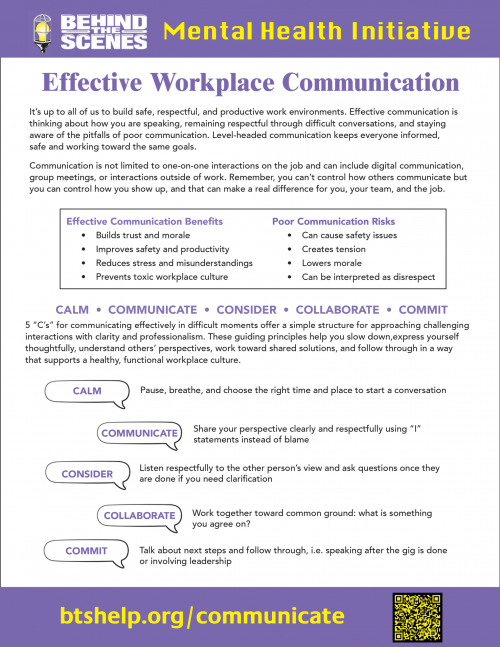
The 5 C’s of Effective Communication offer a simple structure for approaching challenging interactions with clarity and professionalism. These guiding principles help you slow down, express yourself thoughtfully, understand others’ perspectives, work toward shared solutions, and follow through in a way that supports a healthy, functional workplace culture.
CALM – COMMUNICATION – CONSIDER – COLLABORATE – COMMIT
Calm – Pause, breathe, and choose the right time and place to start a conversation
Communicate – Share your perspective clearly and respectfully using “I statements” instead of blame
Consider – Listen actively to the other person’s view and ask questions if you need clarification once they are done speaking
Collaborate – Work together toward common ground: what is something you agree on?
Commit – Talk about next steps and follow through, i.e. speaking after the gig is done or involving leadership
Communication is not limited to one-on-one interactions on the job and can include digital communication, group meetings or trainings, or interactions outside of work. Organizations and leaders can include language in their safety briefings, display posters about workplace behavior standards and encourage opportunities for constructive feedback at all levels.
As a reminder, before each of the 5 C’s you have a choice to continue or exit a conversation- try to do so with respect while always being aware of your safety and the safety of those around you.
Personal Level: Taking Responsibility for Effective Communication
Organizational Level: Leading a Culture of Effective Communication
Cultural Level: Shaping Shared Norms and Expectations
Example 1: Hannah, the experienced hair lead, is struggling to work with Shawn, a younger and less experienced assistant. She finds him overly sensitive and unsure of how to take direction, while Shawn feels Hannah is aggressive and demeaning, despite his efforts to follow instructions. After a heated disagreement, Hannah avoids speaking to Shawn, telling him to “just do your work and stop complaining.” Shawn, feeling frustrated, decides to address the issue using the 5 C’s:
Calm – Shawn pauses, breathes, and decides that speaking to Hannah just after lunch is a good time to talk. Though nervous, he takes a few deep breaths to stay composed before approaching Hannah.
Communicate – Shawn begins by acknowledging Hannah’s experience and focus on efficiency but expresses that raised voices feel disrespectful in a professional environment. Using “I” statements, he shares that personal criticism feels more frequent than constructive feedback and arguing slows them down as they need to pause work to do so.
Consider – Hannah responds defensively, saying she wouldn’t raise her voice if Shawn just listened. Shawn listens without interrupting, keeping open body language to show he is open to what she is saying.
Collaborate – Shawn asks what he can do to demonstrate he’s listening to her constructive feedback. Hannah says he should stop making excuses when receiving notes. Shawn realizes he often deflects to avoid blame out of fear of being yelled at. As Hannah hears this, her posture shifts.
Commit – Shawn agrees to take responsibility without excuses, and Hannah agrees to work on her tone and acknowledge when Shawn accepts feedback constructively.
Example 2: Steven, the Production Stage Manager, witnesses the Assistant Director angrily grab a prop sword backstage, muttering that it “still isn’t the right look” before slamming it down on the table. Joel, the Prop Master, sees it happen and makes eye contact with Steven.The moment feels tense and unprofessional
Calm – Steven observes and waits until the scene ends before addressing it. He privately asks Joel if he’s okay and suggests stepping off deck to talk.
Communicate – Steven says he saw what happened and wants to ensure Joel feels supported. He acknowledges the stress of tech while expressing concern about how the situation was handled. His tone remains calm and non-judgmental.
Consider – Joel shares that he’s been adjusting the sword for days and feels disrespected. He says this reaction isn’t new. Steven listens fully and asks clarifying questions.
Collaborate – Steven asks what support Joel needs and whether he’s open to a mediated conversation. Joel agrees, requesting Steven’s presence. They agree that improving the feedback process would benefit everyone.
Commit – Steven commits to scheduling a conversation with the AD and following up with Joel. Joel commits to participating in the mediated discussion.
Example 3: During dress rehearsal, an actor misses an entrance because a jacket won’t fasten in time. Backstage, the actor snaps, “This costume is sabotaging my performance.” Maya, the Costume Supervisor, feels the comment reflects on her team’s competence.
Calm – Maya feels her pulse jump but responds evenly: “Let’s get through this scene and regroup after.” She prioritizes keeping rehearsal moving and allowing space to cool down.
Communicate – After the run, Maya approaches privately. She says, “I can see this is impacting your performance, and I also want to address how that conversation happened.” She names both the issue and the behavior without attacking.
Consider – The actor explains the quick change creates anxiety and admits reacting out of stress. Maya listens, then explains the team needs specific feedback rather than public frustration and shares how the earlier comment affected morale.
Collaborate – Maya asks, “What exactly is catching?” They identify the lining and clasp as issues and agree to test a magnetic closure and re-time the change. The actor agrees to give notes calmly; Maya agrees to loop them in earlier.
Commit – Maya commits to implementing the change before the next rehearsal and scheduling a dedicated run-through. The actor commits to addressing concerns privately and constructively.
Example 4: On a night exterior shoot, Marcus, a seasoned Key Grip, questions an anchor choice made by Tessa, the newly hired Head Rigger. Tessa responds sharply. The crew goes quiet.
Calm – Marcus suggests, “Let’s take two minutes and look at it together.” His tone stays neutral. Tessa nods.
Communicate – Away from the crew, Marcus expresses concern about lateral sway if wind increases. He focuses on risk, not blame. Tessa acknowledges his experience and explains she ran load calculations.
Consider – Marcus admits part of his reaction relates to process. Tessa shares she’s under production pressure and sometimes feels the need to assert authority firmly. They listen without interrupting.
Collaborate – They review the setup together, add a secondary safety line, and adjust the bridle angle.
Commit – Tessa clearly communicates the adjustment to the crew and thanks Marcus. Marcus publicly supports the change, reinforcing unity and safety.
Example 5: At a busy lighting warehouse, Dana, a Warehouse Lead, notices Chris, a Lighting Tech, stacking heavy fixtures high on a rolling cart near a floor lip known to tip loads.
Calm – Dana walks over instead of shouting. She keeps her voice steady and positions herself in Chris’s line of sight.
Communicate – She says, “Can I pause you? That lip has tipped carts before, especially with weight stacked this high.” She points to the specific hazard. Chris says he knows what he is doing without looking at the lip. Dana firmly and clearly says, “Chris, this is a known issue and your safety as well as the safety of the equipment are not worth the time you may save- take two trips.”
Consider – Chris pauses his work and admits he didn’t realize the risk and was trying to move quickly. Dana acknowledges the pressure and shares a past near-miss.
Collaborate – Dana steps in to help split the load into two stacks and add ratchet straps. Chris asks for help navigating the lip safely.
Commit – Dana commits to flagging the hazard in the next safety huddle and marking it more clearly. Chris commits to asking for help when loads feel unstable.